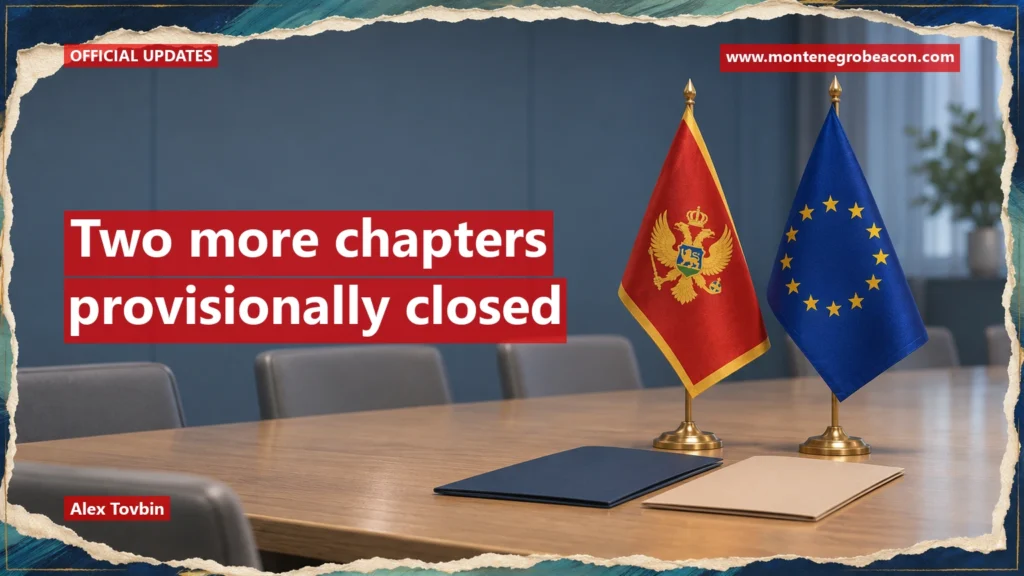
Montenegro and the European Union provisionally closed two more chapters of the country’s accession negotiations at a conference in Brussels on 19 November 2026. Chapter 16 covers taxation. Chapter 22 deals with regional policy and the coordination of structural instruments, the arrangements used to put regional development programmes into practice. The decision took Montenegro to 25 provisionally closed chapters out of 33 opened, leaving eight. Council of the EU announcement
The agreement followed the 6 November conference, when the two sides provisionally closed chapters on the free movement of goods and on food safety, veterinary and phytosanitary policy. The latest figures measure progress across negotiating subjects. For residents and businesses, the useful question is which preparations the decision recognises and which further decisions will determine how they affect everyday life.
What a provisionally closed chapter means
Accession talks are divided into chapters so negotiators can examine one policy area at a time. Each chapter covers part of the EU acquis, the body of common EU rules and obligations that a new member is expected to apply. The work includes checking how national rules align with the EU’s and whether public authorities can put those rules into practice. On taxation, for instance, this means considering how rules are administered as well as what appears in legislation.
Provisional closure records agreement at this stage of the negotiations. The Council says monitoring of alignment and implementation continues throughout the talks. It can return to a chapter if necessary, and agreements on individual chapters become final once there is an overall agreement. That makes the number of closed chapters a useful measure of progress alongside continuing checks on implementation. Council of the EU on the negotiation outcome
What the taxation chapter covers
Chapter 16 covers several areas of alignment, including value added tax, excise duties and direct taxation. The EU common position also discusses administrative cooperation and the ability to apply the revised rules. These are distinct parts of the same work. A provision adopted in a law has to be accompanied by the procedures and administrative capacity needed to apply it consistently. EU common position on Chapter 16
For a business following this news, the immediate development is an agreement on the chapter in Brussels. Any change that affects a specific transaction, tax return or deadline has to be read in the relevant domestic measure and its application dates. As reported by RTCG after the conference, Montenegro’s European affairs minister Maida Gorčević presented greater predictability for businesses and better conditions for investment and trade as aims of the work. The practical effects depend on the measures that are put into operation. RTCG report from the conference
Why the regional policy chapter comes before funding decisions
Chapter 22 is about the structures used to plan regional programmes, manage funding and check how spending is carried out. Cohesion policy is the EU’s framework for supporting development and addressing disparities between regions. Coordination matters because preparing a programme, managing projects and auditing spending are separate responsibilities. The chapter examines the institutions and systems that would carry them out. EU common position on Chapter 22
Montenegro’s authorities describe project preparation as work to do in advance so the country can use cohesion support when it becomes available. For a municipality or other potential applicant, there are several distinct steps between an idea and a funded project. A programme must set out what it supports, the conditions must be published, and individual projects need an approval decision. The 19 November conference took a decision about the negotiating chapter. Readers looking for an opportunity for a particular municipality or project should follow the published programme and application notice for that funding. Montenegrin Ministry of European Affairs
The steps still ahead
Montenegro’s government has said it wants to finish negotiations by the end of 2026. The Irish presidency’s representative, Thomas Byrne, described the December timetable as within reach. The next evidence of progress will come from further accession conferences and their decisions on remaining chapters. The year-end goal concerns concluding talks. The entry date will be set through a separate treaty process. Council of the EU announcement
Once negotiations are complete, the terms are incorporated into an accession treaty. The European Parliament gives its consent and the Council must approve unanimously before the parties sign. Ratification then follows under the parties’ constitutional rules. Membership begins on the date specified in the treaty after those steps are complete. The best way to track these developments is to look for the formal decision associated with each stage: a conference outcome for the chapters, then an accession treaty and its ratifications for membership. Council of the EU guide to enlargement